A New Internet Library: Add Your Website/Blog or Suggest A Website/Blog to our Free Web Directory http://anil.myfunda.net.

Its very simple, free and SEO Friendly.
Submit Now....

Thursday, March 28, 2019

Implementing Weighted, Blended Order-Independent Transparency

Why Transparency?

Result from the Weighted, Blended OIT method described
in this article. Everything gray in the top inset image has some
level of transmission or partial coverage transparency.
See also the new colored transmission method in my next article!

Partially transparent surfaces are important for computer graphics. Realistic materials such as fog, glass, and water as well as imaginary ones such as force-fields and magical spells appear frequently in video games and modeling programs. These all transmit light through their surfaces because of their chemical properties.

Even opaque materials can produce partially transparent surfaces within a computer graphics system. For example, when a fence is viewed from a great distance, an individual pixel may contain both fence posts and the holes between them. In that case, the "surface" of the opaque fence with holes is equivalent to a homogeneous, partly-transparent surface within the pixel. A similar situation arises at the edge of any opaque surface, where the silhouette cuts partly across a pixel. This is the classic partial coverage situation first described for graphics by Porter and Duff in 1986 and modeled with "alpha".

There are some interesting physics and technical details that I'm simplifying in this overview. To dig deeper, I recommend the discussion of the sources and relation between coverage and transmission for non-refractive transparency in the Colored Stochastic Shadow Maps paper that Eric Enderton and I wrote. I extended that discussion in the transparency section of Computer Graphics: Principles and Practice.


The Challenge

Generating real-time images of scenes with partial transparency is challenging. That's because pixels containing partly transparent surfaces have multiple surfaces contributing to the final value, and the order in which they are composited over each other affects the result. This is one reason why hair, smoke, and glass often look unrealistic in video games, especially where they come close to opaque surfaces.

One reason that transparency is challenging is that ordering surfaces is hard. There are many algorithms for ordering elements in a data structure, but they all have a cost in both time and space that is unacceptable for real-time rendering on current computer graphics hardware. If every pixel can store ten partially transparent surfaces, then a rendering system would require ten times as much memory to encode and sort those values. (I'm sure that 100 GB GPUs will exist in a few years, but they don't today, and when they do, we might not want to use all of the memory just for transparency.) It is also not possible to order the surfaces themselves because there is not necessarily any order in which multiple surfaces overlap correctly. For example, as few as three triangles can thwart the sorting approach.

Recently, a number of efficient algorithms for order-independent transparency (OIT) were introduced. These approximate the result of compositing multiple layers without the ordering constraint or unbounded intermediate storage. This can yield two benefits. The first is that the worst cases of incorrectly composited transparency can be avoided. No more bright edges on a tree in shadow or characters standing out from the fog they were hiding in. The second benefit is that multiple transparent primitives can be combined in a single draw call. That gives a significant increase in performance for scenes with lots of foliage or special effects.

All OIT methods make approximations that affect quality. A common assumption is that all partially-transparent surfaces have no refraction and do not color the objects behind them. For example, in this model "green" glass will make everything behind it look green by darkening the distant surfaces and adding green over the top. A distant red object will appear brown (dark red + green), not black as it would in the real world.

Weighted, Blended Order-Independent Transparency is a computer graphics algorithm that I developed with Louis Bavoil at NVIDIA and the support of the rendering team at Vicarious Visions. Compared to other OIT methods, it has the advantages that it uses very little memory, is very fast, and works on all major consoles and PCs released in the past few years. The primary drawbacks are that it produces less distinction between layers close together in depth and must be tuned once for the desired depth range and precision of the applications. Our I3D presentation slides explain these tradeoffs in more detail.


A glass chess set rendered with our technique.

Since publishing and presenting the research paper, I've worked with several companies to integrate our transparency method into their games and content-creation application. This article shares my current best explanation of how to implement it, as informed by that process. I'll give the description in a PC-centric way. See the original paper for notes on platforms that do not support the precisions or blending modes assumed in this guide.

Algorithm Overview

All OIT methods make the following render passes:
  1. 3D opaque surfaces to a primary framebuffer
  2. 3D transparency accumulation to an off-screen framebuffer
  3. 2D compositing transparency over the primary framebuffer
During the transparency pass the original depth buffer is maintained for testing but not written to. The compositing pass is a simple 2D image processing operation.

3D Transparency Pass

This is a 3D pass that submits transparent surfaces in any order. Bind the following two render targets in addition to the depth buffer. Test against the depth buffer, but do not write to it or clear it. The transparent pass shaders should be almost identical to the opaque pass ones. Instead of writing a final color of (r, g, b, 1), they write to each of the render targets (using the default ADD blend equation):

Render TargetFormatClearSrc BlendDst BlendWrite ("Src")
accumRGBA16F(0,0,0,0)ONEONE(r*a, g*a, b*a, a) * w
revealageR8(1,0,0,0)ZEROONE_MINUS_SRC_COLORa

The w value is a weight computed from depth. The paper and presentation describe several alternatives that are best for different kinds of content. The general-purpose one used for the images in this article is:

w = clamp(pow(min(1.0, premultipliedReflect.a * 10.0) + 0.01, 3.0) * 1e8 * pow(1.0 - gl_FragCoord.z * 0.9, 3.0), 1e-2, 3e3);

where gl_FragCoord.z is OpenGL's depth buffer value which ranges from 0 = near plane to 1 = far plane. This function downweights the color contribution of very-low coverage surfaces (e.g., that are about to fade out) and distant surfaces.

Note that the compositing uses pre-multipled color. This allows expressing emissive (glowing) values by writing the net color along each channel instead of explicitly solving the product r*a, etc. For example, a blue lightning bolt can be written to accum as (0, 10, 15, 0.1) rather than creating an artificial unmultiplied r value that must be very large to compensate for the very low coverage.

Using R16F for the revealage render target will give slightly better precision and make it easier to tune the algorithm, but a 2x savings on bandwidth and memory footprint for that texture may make it worth compressing into R8 format.

Sample GLSL shader code is below:
#version 330

out float4 _accum;
out float _revealage;

void writePixel(vec4 premultipliedReflect, vec3 transmit, float csZ) {
/* Modulate the net coverage for composition by the transmission. This does not affect the color channels of the
transparent surface because the caller's BSDF model should have already taken into account if transmission modulates
reflection. This model doesn't handled colored transmission, so it averages the color channels. See

McGuire and Enderton, Colored Stochastic Shadow Maps, ACM I3D, February 2011
http://graphics.cs.williams.edu/papers/CSSM/

for a full explanation and derivation.*/

premultipliedReflect.a *= 1.0 - clamp((transmit.r + transmit.g + transmit.b) * (1.0 / 3.0), 0, 1);

/* You may need to adjust the w function if you have a very large or very small view volume; see the paper and
presentation slides at http://jcgt.org/published/0002/02/09/ */
// Intermediate terms to be cubed
float a = min(1.0, premultipliedReflect.a) * 8.0 + 0.01;
float b = -gl_FragCoord.z * 0.95 + 1.0;

/* If your scene has a lot of content very close to the far plane,
then include this line (one rsqrt instruction):
b /= sqrt(1e4 * abs(csZ)); */
float w = clamp(a * a * a * 1e8 * b * b * b, 1e-2, 3e2);
_accum = premultipliedReflect * w;
_revealage = premultipliedReflect.a;
}

void main() {
vec4 color;
float csZ;
...
writePixel(color, csZ);
}

2D Compositing Pass

The compositing pass can blend the result over the opaque surface frame buffer (as described here), or explicitly read both buffers and write the result to a third.
Render TargetSrc BlendDst BlendWrite ("Src")
screenSRC_ALPHAONE_MINUS_SRC_ALPHA(accum.rgb / max(accum.a, epsilon), 1 - revealage)

I use epsilon = 0.00001 to avoid overflow in the division. It is easy to notice if you're overflowing or underflowing the total 16-bit precision. You'll see either fully-saturated "8-bit" ANSI-style colors (red, green, blue, yellow, cyan, magenta, white), or black dots from floating point specials (Infinity, NaN). If the computation produces floating point specials, they will typically also expand into large black squares under any postprocessed bloom or depth of field filters.

Sample GLSL shader code is below:
#version 330

/* sum(rgb * a, a) */
uniform sampler2D accumTexture;

/* prod(1 - a) */
uniform sampler2D revealageTexture;

void main() {
int2 C = int2(gl_FragCoord.xy);
float revealage = texelFetch(revealageTexture, C, 0).r;
if (revealage == 1.0) {
// Save the blending and color texture fetch cost
discard;
}

float4 accum = texelFetch(accumTexture, C, 0);
// Suppress overflow
if (isinf(maxComponent(abs(accum)))) {
accum.rgb = float3(accum.a);
}
    float3 averageColor = accum.rgb / max(accum.a, 0.00001);


// dst' = (accum.rgb / accum.a) * (1 - revealage) + dst * revealage
gl_FragColor = float4(averageColor, 1.0 - revealage);
}


Examples

I integrated the implementation described in this article into the full open source G3D Innovation Engine renderer (version 10.1). The specific files modified to implement the technique are:


[Nicolas Rougier also contributed a Python-OpenGL implementation with nice commenting and reference images as well. I'm hosting it at http://dept.cs.williams.edu/~morgan/code/python/python-oit.zip.]

All of the following images of the San Miguel scene by Guillermo M. Leal Llaguno were rendered using G3D's implementation. To show how it integrates, these include a full screen-space and post-processing pipeline: ambient occlusion, motion blur, depth of field, FXAA, color grading, and bloom.

The inset images visualize the accum and revealage buffers. Note the combination of glass and partial coverage surfaces.


Here are examples on other kinds of content:


Note that this reference image fixes a typo from the one in the I3D presentation:
the alpha values are 0.75 (not 0.25 as originally reported!) and are given before computing the premultiplied values. So, the blue square is (0, 0, 0.75, 0.75) in pre-multiplied alpha and (0, 0, 1, 0.75) with unmultiplied color.
I'm using a different weighting function from the I3D result as well.


Morgan McGuire (@morgan3d) is a professor of Computer Science at Williams College, a researcher at NVIDIA, and a professional game developer. His most recent games are Rocket Golfing and work on the Skylanders series. He is the author of the Graphics Codex, an essential reference for computer graphics now available in iOS and Web Editions.

Sunken Valley Passage And Riven Cave - Sekiro: Shadows Die Twice Walkthrough (Part 18) - IGN Video

Sunken Valley Passage and Riven Cave - Sekiro: Shadows Die Twice Walkthrough (Part 18)

Get Your Anti-Gravitic Motor Running

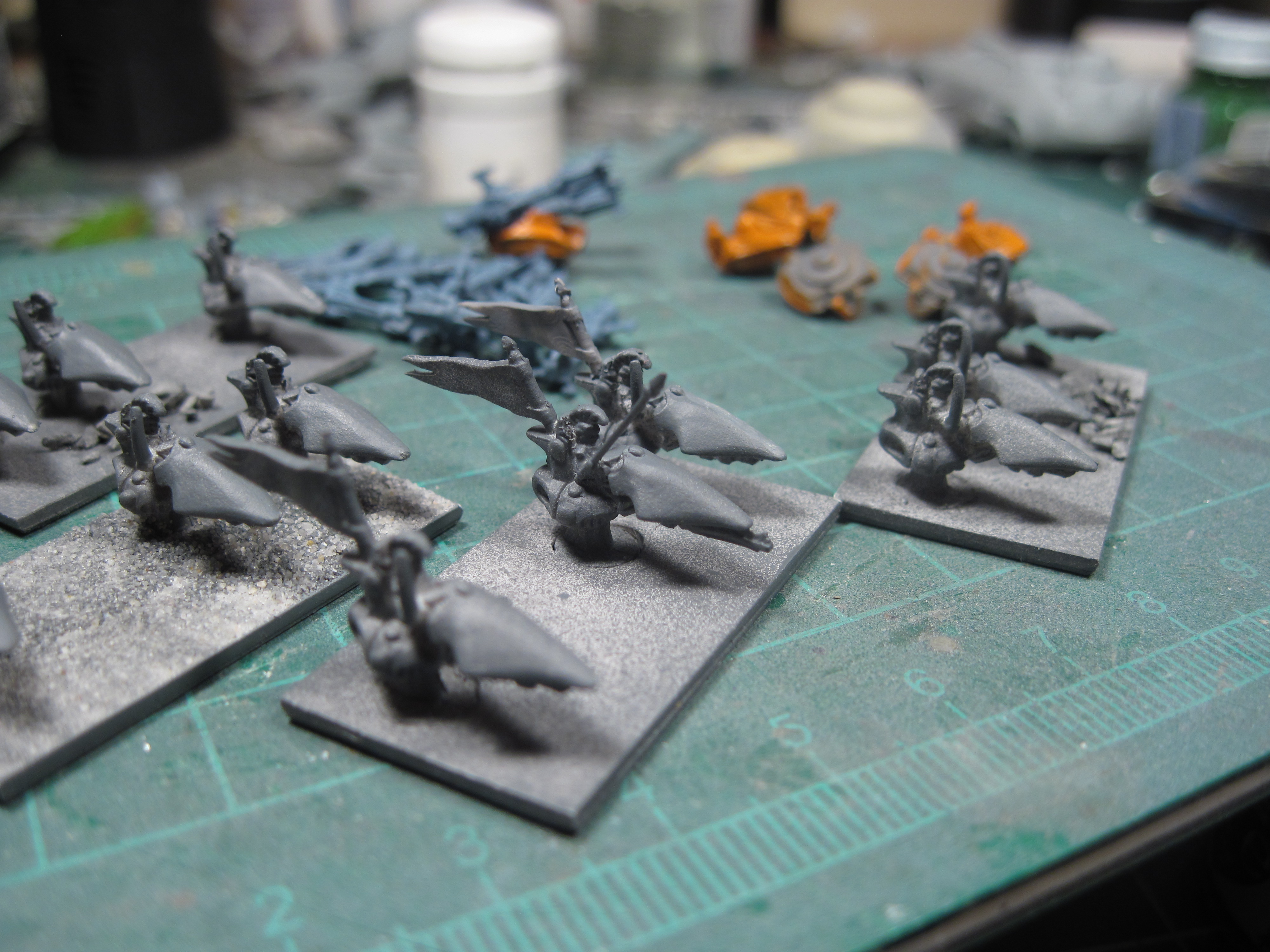
I've been working on the Jetbikes for the last two weeks. Just the orange highlights are left at this point as well as the decals.


I didn't have these ready for Fall In!, but they're going to be getting some paint early next year I think, six custom Night Spinner turrets. I used most of the Forgeworld turret, just replacing the cockpit glass with some from fan-made proxies.


These didn't make it down to Fall In! either but I'm hoping to finish them before the end of the year and EpiComp. They're my Wild Riders, I decided to paint them up in Sunblitz Brotherhood colors.


Wednesday, March 27, 2019

Pubg 0.9 Beta Version Download Now


Hello Friends That is My Blog And I am showing how to download pubg New Version .0.9  On Android Device watch Full Process.


                         Screenshot


🔲Minimum Requirement

⚪️3Gb Ram On Mobile.
⚪️1.47Gb Storage.
⚪️Android version Lolipop.
⚪️3G 4G Network Minimum.

🔲How to Install

⚪️First Download Game  fille.
⚪️AND install Pubg New Beta 0.9 update.

🔲How To Download

The link is available you easily Download The Download link low servers links You Have Maximum Speed Of Downloading.


▬▬▬▬▬▬▬▬▬▬▬▬▬▬▬▬▬▬▬▬▬▬▬▬▬▬▬▬▬▬▬▬▬▬▬▬▬

Download Link 


     Click Here


▬▬▬▬▬▬▬▬▬▬▬▬▬▬▬▬▬▬▬▬▬▬▬▬▬▬▬▬▬▬▬▬▬▬▬▬▬

Tuesday, March 26, 2019

Introduction To Board Game Design (LTUE Panels – 1 Of 4)


This year at Life, the Universe and Everything (LTUE) (website), I participated in the tabletop gaming track. This was a great experience. Not only was I sharing what I've learned over the years writing and editing for and about games, but I learned from others willing to share their experiences. The panels were all titled for board games and the discussions broadened out to include all tabletop gaming.

This is the first of four articles based on my notes.

Panel: Introduction to Board Game Design

A basic overview of the board game creation process, from theme to gameplay to balance.

We started out by asking our audience how many of them have created house rules for a game they like to play. Every hand went up. I believe every person who has ever come up with a house rule, or created their own set of rules using another game's pieces, has developed a game. That's where this seems to always start.

Important Elements

These are not listed in the order of importance. Everyone's creative juices run differently. One person might know who they want to build a game for, while another knows the story they want their game to tell.

Some of these might not even be needed. But, before you exclude it, make sure you know you're cutting that part out of your development process and why.

Audience

It is important to know who is going to be playing your game. You might be creating a game for younger players, or maybe an older group sitting around at a party. They might be looking for something to be done in 30 minutes or something to fill hours. Some will be looking for something that will make them laugh without concern while others want deep strategy that keeps players watching every move taking place.

Every gamer is different in what they like and don't like. They are going to have their own expectations of what should be part of a game they're going to play. There are also expectations for the type of game. War games, dice games, worker placement, narratives, you name your style and there will be a list of things you expect, and others expect those same things.

As you design your game, you need to understand what those expectations are. You either need to meet those expectations or have a good justification to exclude them from your game. For every twist you make on those expectations, you need to know why you're making the change and learn how you're going to present it to keep your audience satisfied.

Story

Most new games tell a story as a major element. From other panels, it was clear most players now like to have some story guiding the game. Story is not an absolute because there are many games built around the mechanics. But let's look at why story can help in development.

Stories are constructed around a sequence of actions that drive the story from its beginning to its conclusion. Sound familiar? When you are developing a game you need to consider what drives the players forward through the game. This can be used from the time the game is set up until the last play takes place.

Story construction can help keep players intrigued. I've had the opportunity of playing games that were not ready for market, or should not have been released. One of the problems is usually the game is flat. A flat game is one where the game doesn't change during play—there is no beginning, middle, and end—the actions are just repetitions of the previous turn. Flat games have their place for newer players. Unfortunately, for experienced gamers, after being played a few times the place these games end up at is usually on the shelf or in the donation bin.

Tower of Madness uses a falling marble mechanic
Think about how your game's story drives change throughout the game. Are their strategy changes, or do the turns kind of blend into each other because you are basically doing the same actions over and over? Those that build and change are the types of games most people want to play again. Replay-ability means they will come back to it.

Mechanics

Games need a mechanic. But which one? There are many mechanics used in games. Sometimes there is only one and other games use more. I am not going to try to list the possibilities because it would take too long and I would miss something. The important part is to find a mechanic fitting to your game's feel and something you can comfortably work with.

Be willing to try different mechanics. I had the opportunity of playing a battle game while in its later stages of development. The designer's goal was to put the players inside a tank during battle. He worked with several mechanics that kept pushing the feel away from the tank and into the broader strategy in the field of battle. He tried different mechanics. He found that using a dice pool allowed for the action to focus the player as the tank commander directing their crew (Tank Brawl review).

He kept his story and feel for the game by finding the right mechanic for that game.

Playtesting

Having people play your game is the end goal. To get a game to that point, it needs to be played through its iterations, its successful steps forward, and those that push it backwards. It needs to be playtested.

Playtesting almost always starts with you, the developer. You have to get it to a point others can start to play. But don't try to make it perfect before others take it up on the playtesting table. It is because it is not ready that you want people playing a prototype. They will help you build a better game. You have your trusted players, and then you have to get it played by those who are not familiar with what you have gone through.

Along with just reaching out to friends, then friends of friends, gaming stores and conventions are great places to find players who are willing to play and give feedback. These don't have to be big national events. Local shops and cons may not have as many people, which can be a benefit. You can get to know those who are in the area and smaller events are usually more flexible with time.

Taking Inspiration from Other Games

Part of SaltCon's Gaming Library
It is important to do research. For developing games, some of the best research is playing games. I know for most game developers, this is a real heartache. I mean when I have to buy another game because I'm doing research, it can be rough. Play games of different types and find out what you like and don't like.

Figure out what makes a game work for you. What elements are part of the game that bring you back to the table to play that one again? Which of those features can you use in your creation?

The games that end up sitting on your shelf gathering dust, the ones you stole the dice out of, can also help you make a better game. There is something about those games you shy away from. What is it? They have a problematic area that you can keep away from with that great game you're creating.

Conclusion

Like the title says, this is an introduction. Every one of these sections can be a series of articles or presentations. Once you get started, you will learn more about what you want to do and how to do it. And the more you do, the better you will become.

Game development is a creative endeavor that can be fulfilling and frustrating at the same time. This is the same for artists of all types. You have a great idea and you need to make it real. So jot down your ideas, break out some butcher paper or a deck of playing cards and a Sharpie. Make something that looks crude so you can start playing. Just get started.

Fellow Panelists (information from program guide)

Carl Duzzett was sent from the future to assassinate the mother of an eventual resistance leader. He married her instead and now designs games and writes speculative fiction with an unfair advantage. carlduzett.net(review of Carl's game Coins)

B.A. Simmons is the author of the Archipelago series, a seafaring science fiction adventure (review of The Voyage of the Entdecker, book one of the series). He lives in Ogden, Utah, where he works full time teaching English and history to junior high students. He is also a collaborator on Planet Archipelago, a table-top RPG set in the same world as his series. basimmonsauthor.com.

Devon Stern has been a hobby board game designer for years and has more recently worked in indie video game development. He loves it when a set of mechanics comes together. puddygum.itch.io.

If you have a comment, suggestion, or critique please leave a comment here or send an email to guildmastergaming@gmail.com.

You can also join Guild Master Gaming on Facebookand Twitter(@GuildMstrGmng).


KING OF WUSHU 3D


Game Description:

Name: 九阳神功起源
Enter the ancient martial arts realm of heroes and villains, noble masters and sinister assassins with King of Wushu.
The land is in chaos, and justice is served at the edge of a blade. Join with teams of friends or strangers in a fun and action-packed Multiplayer Online Battle Arena (MOBA) and discover if you have what it takes to become the King of all Wushu.
Defy gravity with mystical ancient martial arts abilities
Third-person perspective in vividly stylized 3D battlefields
36 distinct kung fu warriors to choose from

Grow your heroes with RPG-style progression systems.

*** Best recommend for whom making money online ***
Payoneer - Sign Up Free: http://rapidteria.com/18077521/payoneer-referral
TransferWise - Sign Up Free: http://rapidteria.com/18077521/transferwise-referral

Follow me via the links below:
Official YouTube Channel:
* Game: https://www.youtube.com/CamboGames
* Music: https://www.youtube.com/CamboREMIX9
Official FaceBook Page:
* Game: https://www.facebook.com/CamboGames/
* Music: https://www.facebook.com/CamboREMIX9/
Official Facebook Publish Group: https://www.facebook.com/groups/CamboGames/
Official Twitter: https://twitter.com/CamboGamesKH
Official Web-Blog:https://cambo-games.blogspot.com/

*** Marketing ***
- There are blank YouTube accounts for sale ($10/Acc). Giving advice to the customer for free every time.
- There are QQ and WeChat accounts for sale ($5/Acc). Free password recovery for the customer every time.
For more info, please inbox to FB Page: https://www.facebook.com/CamboGames/

Click on the button below to download game:
* Note: Just wait 5 seconds finished and click the << SKIP AD >> button.
Big Thanks!


The Analogue Mega Sg – A Preview Of The Next Chapter In The Fpga "Console Wars"

Analogue Mega Sg JPN Version
Today, Analogue has made an announcement of its next FPGA retro console. This was a reveal which had been long expected. When the console was revealed as an implementation of the Sega Genesis/Mega Drive, it came as no great surprise to observers like myself familiar with Analogue's history. Let's explore some of that history, the specifications of the unit, what you will get for the $189.99 retail price and how this console may fare in today's increasingly-crowded retro-console market.

Read more »

Dotnet-Interviews