A New Internet Library: Add Your Website/Blog or Suggest A Website/Blog to our Free Web Directory http://anil.myfunda.net.

Its very simple, free and SEO Friendly.
Submit Now....

Wednesday, April 15, 2020

HOW TO BOOST UP BROWSING SPEED?

Internet speed is the most cared factor when you buy an internet connection. What if still, you face a slow speed browsing problem? No worries, as I came with a solution to this problem. I will let you know how to boost up browsing speed. It's very simple to follow.

SO, HOW TO BOOST UP BROWSING SPEED?

There can be many ways you can get a speedy browsing whether you use paid service or free hacks. I am going to share this free speed hack with you.

STEPS TO FOLLOW

  1. Navigate to Control Panel > Network and Internet Options > Network and Sharing Center.
  2. Now look for the active internet connection to which you're currently connected to.
  3. Open up Connection Properties of your active connection.
  4. Click on IPv4 and open its Properties.
  5. Here you will notice your DNS, you just need to change your DNS address with the following DNS.
    Preferred DNS server: 208.67.222.222
    Alternate DNS server: 208.67.220.220
  6. Once done, save it and no configure it for IPv6. Just change the IPv6 DNS with the following DNS.
    Preferred DNS server: 2620:0:ccc::2

    Alternate DNS server: 2620:0:CCD::2
  7. Finally, save and you're done with it.
That's all. You have successfully learned how to boost up browsing speed. Hope it will work for you. Enjoy speedy internet..!
More articles

Testing SAML Endpoints For XML Signature Wrapping Vulnerabilities

A lot can go wrong when validating SAML messages. When auditing SAML endpoints, it's important to look out for vulnerabilities in the signature validation logic. XML Signature Wrapping (XSW) against SAML is an attack where manipulated SAML message is submitted in an attempt to make the endpoint validate the signed parts of the message -- which were correctly validated -- while processing a different attacker-generated part of the message as a way to extract the authentication statements. Because the attacker can arbitrarily forge SAML assertions which are accepted as valid by the vulnerable endpoint, the impact can be severe. [1,2,3]

Testing for XSW vulnerabilities in SAML endpoints can be a tedious process, as the auditor needs to not only know the details of the various XSW techniques, but also must handle a multitude of repetitive copy-and-paste tasks and apply the appropriate encoding onto each message. The latest revision of the XSW-Attacker module in our BurpSuite extension EsPReSSo helps to make this testing process easier, and even comes with a semi-automated mode. Read on to learn more about the new release! 

 SAML XSW-Attacker

After a signed SAML message has been intercepted using the Burp Proxy and shown in EsPReSSO, you can open the XSW-Attacker by navigating to the SAML tab and then the Attacker tab.  Select Signature Wrapping from the drop down menu, as shown in the screenshot below:


To simplify its use, the XSW-Attacker performs the attack in a two step process of initialization and execution, as reflected by its two tabs Init Attack and Execute Attack. The interface of the XSW-Attacker is depicted below.
XSW-Attacker overview

The Init Attack tab displays the current SAML message. To execute a signature wrapping attack, a payload needs to be configured in a way that values of the originally signed message are replaced with values of the attacker's choice. To do this, enter the value of a text-node you wish to replace in the Current value text-field. Insert the replacement value in the text-field labeled New value and click the Add button. Multiple values can be provided; however, all of which must be child nodes of the signed element. Valid substitution pairs and the corresponding XPath selectors are displayed in the Modifications Table. To delete an entry from the table, select the entry and press `Del`, or use the right-click menu.

Next, click the Generate vectors button - this will prepare the payloads accordingly and brings the Execute Attack tab to the front of the screen.

At the top of the Execute Attack tab, select one of the pre-generated payloads. The structure of the selected vector is explained in a shorthand syntax in the text area below the selector.
The text-area labeled Attack vector is editable and can be used to manually fine-tune the chosen payload if necessary. The button Pretty print opens up a syntax-highlighted overview of the current vector.
To submit the manipulated SAML response, use Burp's Forward button (or Go, while in the Repeater).

Automating XSW-Attacker with Burp Intruder

Burp's Intruder tool allows the sending of automated requests with varying payloads to a test target and analyzes the responses. EsPReSSO now includes a Payload Generator called XSW Payloads to facilitate when testing the XML processing endpoints for XSW vulnerabilities. The following paragraphs explain how to use the automated XSW attacker with a SAML response.

First, open an intercepted request in Burp's Intruder (e.g., by pressing `Ctrl+i`). For the attack type, select Sniper. Open the Intruder's Positions tab, clear all payload positions but the value of the XML message (the `SAMLResponse` parameter, in our example). Note: the XSW-Attacker can only handle XML messages that contain exactly one XML Signature.
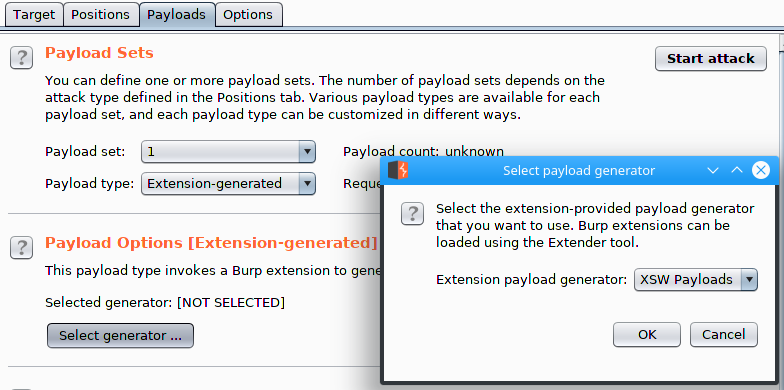
Next, switch to the Payloads tab and for the Payload Type, select Extension-generated. From the newly added Select generator drop-down menu, choose XSW Payloads, as depicted in the screenshot below.


While still in the Payloads tab, disable the URL-encoding checkbox in the Payload Encoding section, since Burp Intruder deals with the encoding automatically and should suffice for most cases.
Click the Start Attack button and a new window will pop up. This window is shown below and is similar to the XSW Attacker's Init Attack tab.


Configure the payload as explained in the section above. In addition, a schema analyzer can be selected and checkboxes at the bottom of the window allow the tester to choose a specific encoding. However, for most cases the detected presets should be correct.

Click the Start Attack button and the Intruder will start sending each of the pre-generated vectors to the configured endpoint. Note that this may result in a huge number of outgoing requests. To make it easier to recognize the successful Signature Wrapping attacks, it is recommended to use the Intruder's Grep-Match functionality. As an example, consider adding the replacement values from the Modifications Table as a Grep-Match rule in the Intruder's Options tab. By doing so, a successful attack vector will be marked with a checkmark in the results table, if the response includes any of the configure grep rules.

Credits

EsPReSSO's XSW Attacker is based on the WS-Attacker [4] library by Christian Mainka and the original adoption for EsPReSSO has been implemented by Tim Günther.
Our students Nurullah Erinola, Nils Engelberts and David Herring did a great job improving the execution of XSW and implementing a much better UI.

---

[1] On Breaking SAML - Be Whoever You Want to Be
[2] Your Software at My Service
[3] Se­cu­ri­ty Ana­ly­sis of XAdES Va­li­da­ti­on in the CEF Di­gi­tal Si­gna­tu­re Ser­vices (DSS)
[4] WS-Attacker

Related news


How Do I Get Started With Bug Bounty ?

How do I get started with bug bounty hunting? How do I improve my skills?


These are some simple steps that every bug bounty hunter can use to get started and improve their skills:

Learn to make it; then break it!
A major chunk of the hacker's mindset consists of wanting to learn more. In order to really exploit issues and discover further potential vulnerabilities, hackers are encouraged to learn to build what they are targeting. By doing this, there is a greater likelihood that hacker will understand the component being targeted and where most issues appear. For example, when people ask me how to take over a sub-domain, I make sure they understand the Domain Name System (DNS) first and let them set up their own website to play around attempting to "claim" that domain.

Read books. Lots of books.
One way to get better is by reading fellow hunters' and hackers' write-ups. Follow /r/netsec and Twitter for fantastic write-ups ranging from a variety of security-related topics that will not only motivate you but help you improve. For a list of good books to read, please refer to "What books should I read?".

Join discussions and ask questions.
As you may be aware, the information security community is full of interesting discussions ranging from breaches to surveillance, and further. The bug bounty community consists of hunters, security analysts, and platform staff helping one and another get better at what they do. There are two very popular bug bounty forums: Bug Bounty Forum and Bug Bounty World.

Participate in open source projects; learn to code.
Go to https://github.com/explore or https://gitlab.com/explore/projects and pick a project to contribute to. By doing so you will improve your general coding and communication skills. On top of that, read https://learnpythonthehardway.org/ and https://linuxjourney.com/.

Help others. If you can teach it, you have mastered it.
Once you discover something new and believe others would benefit from learning about your discovery, publish a write-up about it. Not only will you help others, you will learn to really master the topic because you can actually explain it properly.

Smile when you get feedback and use it to your advantage.
The bug bounty community is full of people wanting to help others so do not be surprised if someone gives you some constructive feedback about your work. Learn from your mistakes and in doing so use it to your advantage. I have a little physical notebook where I keep track of the little things that I learnt during the day and the feedback that people gave me.


Learn to approach a target.
The first step when approaching a target is always going to be reconnaissance — preliminary gathering of information about the target. If the target is a web application, start by browsing around like a normal user and get to know the website's purpose. Then you can start enumerating endpoints such as sub-domains, ports and web paths.

A woodsman was once asked, "What would you do if you had just five minutes to chop down a tree?" He answered, "I would spend the first two and a half minutes sharpening my axe."
As you progress, you will start to notice patterns and find yourself refining your hunting methodology. You will probably also start automating a lot of the repetitive tasks.

Continue reading
  1. Pentest Box Tools Download
  2. Hack Tools For Games
  3. Pentest Tools Website Vulnerability
  4. Tools Used For Hacking
  5. Pentest Tools
  6. Pentest Tools Bluekeep
  7. Top Pentest Tools
  8. Pentest Tools Open Source
  9. Pentest Tools List
  10. Free Pentest Tools For Windows
  11. Hacking Tools 2020
  12. Pentest Tools Find Subdomains
  13. Hacker Tools Software
  14. Pentest Tools
  15. Hacker Tools Windows

Cómo Recuperar La Clave De Inicio De Windows

Somos muchos los que tenemos nuestra PC con clave de administrador y nos hemos olvidado por completo de los dígitos que alguna vez le pusimos para proteger nuestra información. En algunos casos vemos mucha dificultad y nos preguntamos, ¿cómo puedo ingresar sin la necesidad de perder mi información? Hoy en día sobran las posibilidades de poder ingresar a una cuenta de usuario en diferentes métodos gracias a los sorprendentes avances tecnológicos que nos encontramos a diario y que nos evitan la necesidad de llamar a un técnico.
Si en algún caso decimos que hemos perdido la contraseña y que no podemos ingresar al sistema, la respuesta siempre seria que debemos ponernos  en contacto con el administrador del equipo para que se restablezca la contraseña o tener un dominio..Aaaa pueden creerlo!! De esta manera nunca vamos a poder ingresar a nuestra cuenta. 

Cómo recuperar el Password de administrador en Windows

www.dominatupc.com.co

Existe el mejor método para realizar este procedimiento y de esta manera poder recuperar esos proyectos que por minutos pensamos que perderíamos. Pero descuida, ya cuenta con Total Windows Password Reset la mejor herramienta más potente que podrás recuperar claves perdidas de administrador para dominios Windows. 

Este poderoso software cuanta con la facilidad de recuperar contraseñas de los sistemas operativos Windows 10/8.1/8/7/XP/Vista de (64 y 32 Bits) y a nivel de servidores es compatible con versiones de Windows Server 2012 (R2)/2008 (R2)/2003 (R2), realmente una Aplicación útil para los administradores de sistemas como para usuarios.
domina tu pc

¿Cómo funciona?

Para recuperar nuestro Password debemos descargar el Software y ejecutarlo desde una memoria USB (Pendrive). Debemos seguir unos pasos muy simples para conseguir una memoria booteable, sin comando o complejos procedimiento sin necesidad. En el siguiente Vídeo explican de fondo todos los atajos a seguir, está muy claro y sabemos que lo puedes lograr.

A partir de ahora ya no será un dolor de cabeza si olvidas la clave de tu computadora, con esta herramienta ya configurada en la memoria USB, la puedes llevar a cualquier lado y usarla cuantas veces sea necesario. Tanto así, que nos atrevemos a decir que cualquier persona por poco conocimiento en informática podrá resetear un Password sin necesidad de haber leído el manual.

Para los interesados en hacer uso de este Software solo sigan el link que los re-direccionara a la página antes mencionada. 

Descargar Rufus (Opción 1)


Descargar Rufus (Opción 2)
Windows Recovery Password
comparta para que muchas más personas hagan uso adecuando de este programa. De igual manera te invitamos a leer: (3 formas de eliminar archivos imposibles de Windows)

More articles
  1. Hack Tools
  2. Pentest Tools Android
  3. Hacker Tools For Mac
  4. How To Make Hacking Tools
  5. Hacking Apps
  6. Install Pentest Tools Ubuntu
  7. Hack Tool Apk No Root
  8. Hacker Tools For Mac
  9. Hacking Tools For Windows Free Download
  10. Hack Apps
  11. Hacking Tools Pc
  12. Pentest Tools Open Source
  13. Computer Hacker
  14. Github Hacking Tools
  15. Easy Hack Tools
  16. Pentest Tools
  17. Hack Tools For Games
  18. Hacking Tools Kit

Tuesday, April 14, 2020

OWASP API Security Project Media Coverage


A list of must read articles on OWASP API Security Project: 

Read more


PHoss: A Password Sniffer


"PHoss is a sniffer. A normal sniffer software is designed to find problems in data communication on the network. PHoss is designed to know some protocols which use (or may use) clear text passwords. Many protocols are designed to use secure authentication. For fallback they define a lowest level of authentication using clear text. Many companies use this lowest fallback definition as standard setting to make the product working in many environments." read more...

Download: http://www.phenoelit-us.org/phoss/download.html

More articles


CEH: Fundamentals Of Social Engineering


Social engineering is a nontechnical method of breaking into a system or network. It's the process of deceiving users of a system and convincing them to perform acts useful to the hacker, such as giving out information that can be used to defeat or bypass security mechanisms. Social engineering is important to understand because hackers can use it to attack the human element of a system and circumvent technical security measures. This method can be used to gather information before or during an attack.

A social engineer commonly uses the telephone or Internet to trick people into revealing sensitive information or to get them to do something that is against the security policies of the organization. By this method, social engineers exploit the natural tendency of a person to trust their word, rather than exploiting computer security holes. It's generally agreed that users are the weak link in security; this principle is what makes social engineering possible.

The most dangerous part of social engineering is that companies with authentication processes, firewalls, virtual private networks, and network monitoring software are still wide open to attacks, because social engineering doesn't assault the security measures directly. Instead, a social-engineering attack bypasses the security measures and goes after the human element in an organization.

Types of Social Engineering-Attacks

There are two types of Social Engineering attacks

Human-Based 

Human-based social engineering refers to person-to-person interaction to retrieve the desired information. An example is calling the help desk and trying to find out a password.

Computer-Based 

​Computer-based social engineering refers to having computer software that attempts to retrieve the desired information. An example is sending a user an email and asking them to reenter a password in a web page to confirm it. This social-engineering attack is also known as phishing.

Human-Based Social Engineering

Human-Based further categorized as follow:

Impersonating an Employee or Valid User

In this type of social-engineering attack, the hacker pretends to be an employee or valid user on the system. A hacker can gain physical access by pretending to be a janitor, employee, or contractor. Once inside the facility, the hacker gathers information from trashcans, desktops, or computer systems.

Posing as an Important User

In this type of attack, the hacker pretends to be an important user such as an executive or high-level manager who needs immediate assistance to gain access to a computer system or files. The hacker uses intimidation so that a lower-level employee such as a help desk worker will assist them in gaining access to the system. Most low-level employees won't question someone who appears to be in a position of authority.

Using a Third Person

Using the third-person approach, a hacker pretends to have permission from an authorized source to use a system. This attack is especially effective if the supposed authorized source is on vacation or can't be contacted for verification.

Calling Technical Support

Calling tech support for assistance is a classic social-engineering technique. Help desk and technical support personnel are trained to help users, which makes them good prey for social-engineering attacks.

Shoulder Surfing 

Shoulder surfing is a technique of gathering passwords by watching over a person's shoulder while they log in to the system. A hacker can watch a valid user log in and then use that password to gain access to the system.

Dumpster Diving

Dumpster diving involves looking in the trash for information written on pieces of paper or computer printouts. The hacker can often find passwords, filenames, or other pieces of confidential information.

Computer-Based Social Engineering

Computer-based social-engineering attacks can include the following:
  • Email attachments
  • Fake websites
  • Pop-up windows


Insider Attacks

If a hacker can't find any other way to hack an organization, the next best option is to infiltrate the organization by getting hired as an employee or finding a disgruntled employee to assist in the attack. Insider attacks can be powerful because employees have physical access and are able to move freely about the organization. An example might be someone posing as a delivery person by wearing a uniform and gaining access to a delivery room or loading dock. Another possibility is someone posing as a member of the cleaning crew who has access to the inside of the building and is usually able to move about the offices. As a last resort, a hacker might bribe or otherwise coerce an employee to participate in the attack by providing information such as passwords.

Identity Theft

A hacker can pose as an employee or steal the employee's identity to perpetrate an attack. Information gathered in dumpster diving or shoulder surfing in combination with creating fake ID badges can gain the hacker entry into an organization. Creating a persona that can enter the building unchallenged is the goal of identity theft.

Phishing Attacks

Phishing involves sending an email, usually posing as a bank, credit card company, or other financial organization. The email requests that the recipient confirm banking information or reset passwords or PINs. The user clicks the link in the email and is redirected to a fake website. The hacker is then able to capture this information and use it for financial gain or to perpetrate other attacks. Emails that claim the senders have a great amount of money but need your help getting it out of the country are examples of phishing attacks. These attacks prey on the common person and are aimed at getting them to provide bank account access codes or other confidential information to the hacker.

Online Scams

Some websites that make free offers or other special deals can lure a victim to enter a username and password that may be the same as those they use to access their work system.
The hacker can use this valid username and password once the user enters the information in the website form. Mail attachments can be used to send malicious code to a victim's system, which could automatically execute something like a software keylogger to capture passwords. Viruses, Trojans, and worms can be included in cleverly crafted emails to entice a victim to open the attachment. Mail attachments are considered a computer-based social-engineering attack.

Read more


Dotnet-Interviews